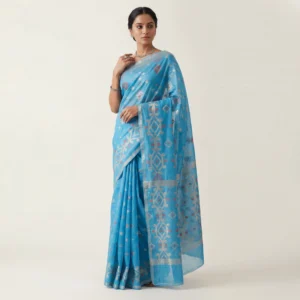
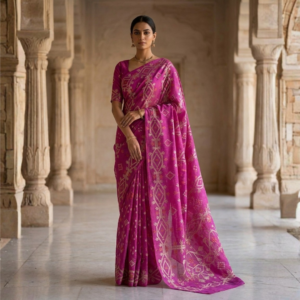
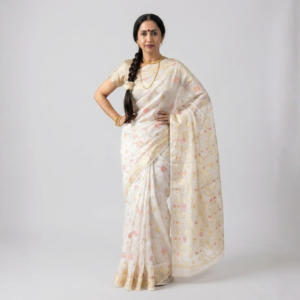
Premium Jamdani Saree Price in Bangladesh 2026
Jamdani saree price in Bangladesh can swing quite a bit once you start comparing across sellers, and
a large part of that gap comes down to how much handwork actually went into the piece. Some stores
position Jamdani as a general luxury category alongside designer wear and premium ready-to-wear
pieces, which often pushes prices up without necessarily reflecting the weaving effort behind each
saree. At Abhrikaa by Eka, we take a more grounded approach,
pricing every Jamdani saree based on the actual technique, motif density, and fabric used.
What Defines a Genuine Jamdani Saree
Jamdani is a supplementary weft weaving technique, which means the motifs are woven directly into the
fabric as it's being made, not printed or embroidered on afterward. That's what gives a real Jamdani
saree its distinct texture, you can often feel the motif slightly raised against the base fabric if
you run your fingers across it. Our collection sticks strictly to this handloom process, whether the
base is half silk, cotton, or a silk blend.
This matters because the term Jamdani gets used loosely across the market. Some listings labelled as
Jamdani are actually machine woven or printed replicas that mimic the look without the underlying
craft. When you are comparing Jamdani saree prices in Bangladesh, it helps to check whether the
listing specifies handloom weaving or simply uses the name as a style descriptor.
Why Jamdani Saree Prices Vary So Widely
A few factors consistently drive the price range you will see across different sellers. The density
of the motif work is probably the biggest one. A saree with scattered butis across the body will cost
less than one with an elaborately worked pallu covered in diamond lattices or floral patterns, simply
because the second one takes considerably longer on the loom.
The fabric base also plays a role. Half silk Jamdani sarees tend to sit at a more accessible price
point compared to pure silk versions, since less silk yarn goes into the weave. Zari quality matters
too. Genuine metallic zari threads cost more than synthetic alternatives that are sometimes used to
bring prices down, so it's worth checking the fabric details on any listing before assuming a lower
price means better value.
Where the saree was woven also factors in. Traditional weaving clusters known specifically for Jamdani
work often carry pricing that reflects generational skill and technique, not just raw material cost.
How We Approach Pricing at Abhrikaa by Eka
We list the fabric composition, the type of zari used, and the specific motif style for every Jamdani
saree in our collection. This way, when you're weighing a Jamdani saree price in Bangladesh against
what you're actually getting, the decision is based on real information rather than photos and
guesswork. We also don't inflate prices to create the illusion of a discount later, which is a
pattern worth watching for on some marketplaces positioning Jamdani as a premium, high margin
category.
Styling Your Jamdani Saree
Jamdani sarees naturally suit festive occasions, weddings, and cultural celebrations, given the
intricacy of the pallu work and the way the motifs catch light. A saree with a denser pallu and
subtler body pairs well with statement jewellery, while one with all-over motif work often looks best
kept simple in terms of accessories, letting the weave itself carry the look.
Caring for a Jamdani Saree
Because Jamdani work involves fine zari and thread detailing, we recommend dry cleaning for the
first wash to protect the motifs. After that, gentle hand washing in cold water works well for
maintenance.
Always dry in shade rather than direct sunlight, since prolonged sun exposure can dull both the
fabric colour and the zari shine over time.
Browse the Collection
If you are looking for a Jamdani saree that reflects genuine handloom craft rather than a mass
produced approximation, our collection is built around exactly that standard. Compare the fabric,
motif style, and zari details on each listing, and choose a piece that fits both the occasion and
your budget.